

5 features a good professional electrical tester should have
Compartir
Choosing a professional electrical tester is not just a matter of comparing prices or checking how many functions it has. Safety, compatibility with different installations, measurement capabilities, and ease of documenting results are factors that can make a significant difference in day-to-day work.
For electricians, installers, and maintenance technicians, having the right instrument makes it easier to carry out different testing tasks and provides useful information for assessing the condition of an installation.
But what should you look for before buying a multifunction electrical tester?
In this guide, we look at five essential features to consider when choosing professional measuring equipment, especially when working in residential, commercial, or industrial environments.
1. Electrical safety: not all testers are designed for the same environments
The first feature to consider is the instrument’s safety rating.
Electrical measuring equipment has overvoltage categories that indicate the transient exposure conditions it is designed to withstand.
The most common categories include:
- CAT II: associated with certain equipment and circuits connected to low-voltage installations.
- CAT III: associated with measurements on parts of the fixed installation, such as distribution circuits and certain electrical panels.
- CAT IV: associated with points close to the origin of the low-voltage installation, where more demanding transient overvoltage conditions may occur.
It is important to remember that the safety category and rated voltage must be considered together.
For example, a CAT IV 600 V rating does not mean the equipment can measure any voltage up to 600 V. The actual measurement range should be checked separately in the datasheet.
Why is it important to choose correctly?
An instrument with an unsuitable overvoltage category may not provide the level of protection required at the measurement point.
Before buying, check the CAT rating, the standards declared by the manufacturer, and the instrument’s operating conditions, including those for its accessories.
Professional tip: if you work on different types of installations, make sure the equipment’s safety category is suitable for the measurement points involved, not just for the system’s usual voltage.
2. Versatility: a good tester should adapt to different installations
Professional electricians may work in homes, commercial premises, office buildings, or industrial installations.
Each environment has different characteristics and testing requirements.
That is why, before choosing an electrical tester, it is worth checking that it is compatible with the power supply configurations you commonly encounter.
Single-phase, bi-phase, and three-phase
Not all instruments support the same supply configurations.
Some are designed primarily for single-phase circuits, while others also support bi-phase or three-phase connections using specific accessories.
This versatility can be especially useful for professionals carrying out maintenance work on installations with different characteristics.
It is also important to check which functions are available in each configuration, since compatibility with a supply system does not necessarily mean that all tests can be carried out in the same way.
Different types of protective devices
Another important consideration is the range of residual current devices (RCDs) the equipment can test.
Some instruments are designed only for testing 30 mA RCDs, while others allow you to select higher rated currents or test selective devices.
Professional tip: choose equipment based on the protective devices you actually need to verify, taking into account their types, rated currents, and test procedures.
3. Measurement capabilities: more than just checking for voltage
A basic electrical tester may be sufficient for certain simple tasks.
However, professional installation and maintenance work may require additional measurement functions.
Some of the most useful include:
True RMS (TRMS) voltage measurement
This measures the RMS value of an AC voltage, even when its waveform is not perfectly sinusoidal, within the conditions specified for the instrument.
Loop and line impedance
L-PE loop impedance measurement provides information about the fault loop, while L-N or L-L line measurements allow other electrical paths to be assessed.
These functions can be useful for obtaining information about installation conditions and prospective fault or short-circuit currents.
RCD testing
In addition to identifying the device type and rated current, it is important to know which test modes the tester offers.
Some equipment includes automatic tests and ramp tests, which provide additional information about the RCD’s response.
Harmonic analysis
Electronic loads can introduce distortion into the electrical voltage.
Harmonic and total harmonic distortion (THD%) measurements can help identify signs that may warrant a more detailed analysis of the network.
Not all these functions are necessary for every professional. What matters is identifying which ones add real value to your regular tasks.
4. Portability and ease of use: key factors in day-to-day work
Technical features are important, but so is ease of use.
A professional tester may be used at different locations throughout the day: homes, commercial premises, technical rooms, or electrical panels.
That is why it is worth considering features such as:
-
Instrument size and weight.
-
Screen readability.
-
Ease of selecting functions.
-
Available connection accessories.
-
Power supply and operating time.
-
Ability to transport the equipment safely.
Is a compact instrument better?
It depends on the tasks you need to perform.
Compact instruments can be especially practical for frequent service visits and occasional checks.
However, portability should not be the only selection criterion. You need to confirm that the instrument offers the right functions, ranges, and safety features.
Professional tip: look for a balance between testing capabilities, portability, and ease of use.
5. Connectivity and results recording: increasingly important features
In professional maintenance, taking a measurement is only part of the process.
Many jobs also require recording results, keeping information about service work, and preparing technical documentation.
That is why connectivity has become a useful feature to consider when choosing an electrical tester.
What are the benefits of an instrument with memory and Bluetooth?
An instrument with these features can make it easier to:
-
Store measurements.
-
Review results later.
-
Transfer information to compatible devices.
-
Prepare technical reports.
-
Organize and trace completed tests.
The availability of these features alone does not guarantee that a report meets all regulatory requirements. Its contents must be tailored to the type of installation and the applicable verification procedure.
Even so, an integrated recording system can simplify some of the paperwork.
FASTCHECK4010: a multifunction tester with all these features
After reviewing the five criteria above, it is easier to assess what a professional instrument should offer.
In this context, the new FASTCHECK4010 expands the capabilities of the FASTCHECK range with functions designed for more demanding testing.
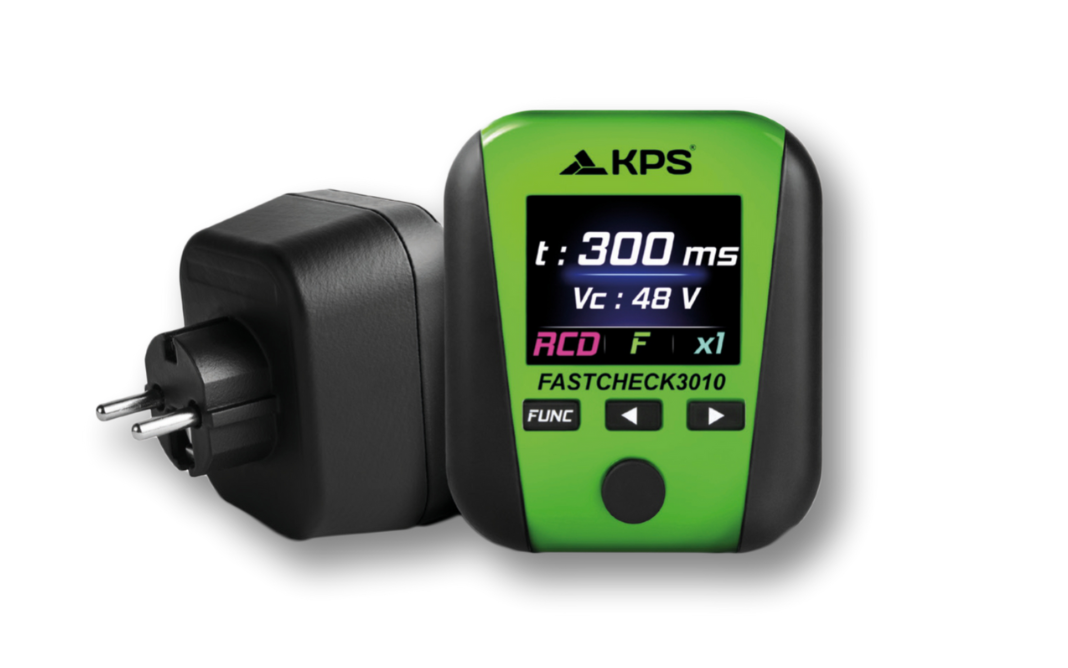
Its design retains the compact pocket-sized format while adding greater measurement and testing capabilities.
What does the new FASTCHECK4010 offer?
CAT IV 600 V safety rating
It has a CAT IV 600 V overvoltage category, suitable for the operating conditions corresponding to that rating.
Compatible with different supply systems
It can take measurements in single-phase, bi-phase, and three-phase systems using the appropriate accessory, with True RMS voltage measurement up to 440 V.
RCD tests up to 1 A
It supports testing AC, A, and F type RCDs, both general and selective, with rated test currents of 30, 100, 300, 500, 650 mA, and 1 A.
It also includes automatic modes and a ramp test for 30 mA RCDs.
Loop and line impedance measurement
It can measure L-PE, L-N, and L-L impedance, as well as prospective earth fault and short-circuit currents.
It features a 7 mA low-current loop test option to reduce the risk of unwanted tripping.
Harmonic analysis
It includes voltage harmonic analysis up to the 50th order and total harmonic distortion (THD%) measurement.
Compact design and connectivity
Weighing just 110 grams, it features a 1.77-inch TFT screen, memory for 64 records, and Bluetooth, allowing users to manage results and generate reports using the KPS FASTCHECK app.
It also incorporates supercapacitor technology to maintain power temporarily when disconnected from the mains.
Which professionals might find it useful?
The FASTCHECK4010 may be worth considering for:
- Electricians working with different power supply configurations.
- Electrical installation companies that need to test RCDs with different rated currents.
- Maintenance technicians working in commercial buildings and industrial installations.
- Professionals looking for a compact instrument with advanced testing functions.
- Technical teams that need to store results and prepare reports using a mobile app.
Its suitability should always be assessed based on the tests required, the installation characteristics, and the manufacturer’s specifications.
What should you check before buying a multifunction tester?
Before choosing an instrument, review these five points:
-
Make sure its safety category is suitable for the measurement points.
-
Check that it supports the supply configurations you work with.
-
Make sure it includes the tests and measurement ranges you need.
-
Check that it is comfortable to carry and use.
-
Make sure it can document results if your work requires it.
It is also worth checking which accessories are included and confirming which tests require additional instruments.
A multifunction tester does not automatically replace all the equipment needed for a complete regulatory verification.
Frequently asked questions about professional electrical testers
What is the difference between a basic electrical tester and a multifunction tester?
A basic tester usually performs a limited number of checks, such as detecting certain wiring faults. A multifunction instrument includes other measurements and tests, depending on the model.
What does CAT IV 600 V mean?
It is a safety classification related to the instrument’s resistance to certain transient overvoltage conditions at CAT IV measurement points, up to its specified rated voltage. It should not be confused with the instrument’s measurement range.
Can all testers measure three-phase systems?
No. You need to check each instrument’s compatibility, required accessories, and available functions for that configuration.
Is it important for a tester to have Bluetooth?
It depends on the work. Bluetooth can be especially useful when you need to save results, review them later, or prepare reports.
Does the FASTCHECK4010 replace all electrical testing instruments?
Not necessarily. Although it combines numerous functions, certain tests may require additional dedicated instruments.
Discover the new FASTCHECK4010
Choosing a professional electrical tester means finding a balance between safety, versatility, technical capabilities, and ease of use.
The new FASTCHECK4010 combines these features in a compact format, with a CAT IV 600 V rating, RCD tests up to 1 A, loop and line impedance measurement, harmonic analysis, and Bluetooth connectivity.
An interesting solution for professionals who need to expand their testing capabilities without giving up a lightweight, portable instrument.
Discover the new FASTCHECK4010 in our online store and explore its full specifications, accessories, and availability.
SEE THE NEW FASTCHECK4010 IN OUR ONLINE STORE
Electrical measurements and tests must be performed by qualified personnel, following safety procedures, the manufacturer’s instructions, and applicable regulations.
