

How to test RCDs and loop impedance in 230 V electrical installations
Compartir
How do you know if a residual current device (RCD) is working correctly?
What information does loop impedance provide?
And which instrument should be used when an installation has a 230 V bi-phase power supply?
These are common questions for electricians, installers, and electrical maintenance professionals.
Checking that a socket has power is only part of the job. To evaluate the safety conditions of an installation, it is also important to verify the wiring, the operation of protective devices, and specific electrical parameters.
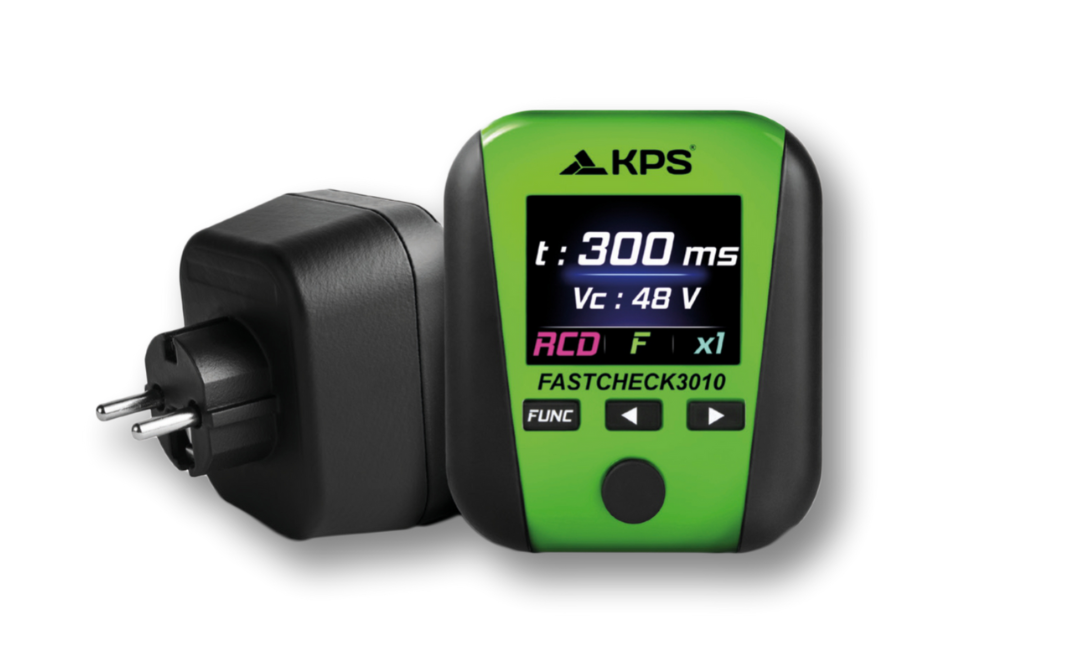
In this guide, we explain what these checks provide and present a compact solution for carrying them out: the KPS FASTCHECK3010, a multifunctional electrical tester that includes RCD testing, loop impedance measurement, and compatibility with 230 V bi-phase circuits.
1. Which checks are important in an electrical installation?
An installation may supply electricity while still presenting wiring problems or protection conditions that require review.
Among the checks a professional may need to perform are:
- Wiring verification: identifying incorrect connections, reversals, or disconnected conductors.
- Voltage measurement: checking the RMS value of the supply voltage.
- RCD testing: evaluating the response of certain residual current protection devices.
- Loop impedance measurement: obtaining information about the conditions of the fault circuit.
- Harmonic analysis: identifying distortion components in the electrical voltage.
Each one provides different information. Therefore, it is important to select an instrument suitable for the characteristics of the installation and the required verification procedure.
2. How to check a 30 mA RCD and how to interpret the results
Residual current devices (RCDs) are used to detect certain residual currents and disconnect the circuit when the corresponding tripping conditions are met.
However, just because an RCD is installed does not mean its response has been verified.
To evaluate its operation, tests can be performed with controlled test currents using a suitable tester.
What do the x1/2, x1, and x5 tests mean?
In RCD testers, these designations refer to multiples of the device's rated residual operating current.
| Test | Current for a 30 mA RCD | Purpose |
|---|---|---|
| x1/2 | 15 mA | Check for no-trip under corresponding test conditions |
| x1 | 30 mA | Evaluate tripping at the rated residual current |
| x5 | 150 mA | Evaluate response with a higher test current |
The results must be interpreted according to the type of RCD, applicable regulations, and test conditions.
It is also relevant to distinguish between AC, A, and F type RCDs, as they are designed to respond to different forms of residual current.
A compact tester for 30 mA RCDs
The KPS FASTCHECK3010 allows for testing 30 mA RCDs of types AC, A, and F.
It features x1/2, x1, and x5 modes, 0° or 180° phase selection, and automatic testing. Additionally, it allows for measuring trip time and contact voltage.
These functions offer the professional useful information to evaluate the response of compatible devices.
Discover the RCD testing features of the KPS FASTCHECK3010
3. What is loop impedance and why is it important to measure it?
Loop impedance represents the electrical opposition of the path that a fault current would follow.
It is a relevant parameter because it influences the current that can flow during a fault and the operating conditions of protection devices.
Its interpretation depends on the grounding scheme of the installation.
Loop impedance in TT systems
In TT systems, the grounding of the installation's exposed conductive parts is independent of the power supply grounding.
Loop measurements can provide information related to the fault circuit and grounding, although they should not be automatically confused with an independent earth resistance measurement.
Loop impedance in TN systems
In TN systems, the fault circuit uses a return path associated with the protective conductor and power supply system.
Loop impedance measurement allows for obtaining information to evaluate protection conditions against faults.
How to reduce unwanted trips during measurement?
In certain installations, the currents used during a loop test can cause an RCD to trip.
To minimize this risk, some instruments incorporate reduced-current tests.
The KPS FASTCHECK3010 offers loop impedance measurement between 0.01 and 999 Ω, with a standard test current of 15 mA and a reduced 6 mA option, according to the manufacturer's data sheet.
The latter is intended to reduce the risk of unwanted trips, although it does not guarantee that they will never occur.
4. How to check 230 V bi-phase installations
Not all 230 V installations have the same power supply configuration.
In a conventional single-phase installation, voltage is obtained between phase and neutral. In certain bi-phase circuits, however, 230 V is available between bi phase conductors.
This difference can determine the choice of measurement instrument.
A tester designed solely for a phase-neutral configuration should not be automatically considered compatible with every bi-phase circuit.
KPS FASTCHECK3010: compatible with single-phase and bi-phase networks
One of the features of the FASTCHECK3010 is its ability to work with L-N connections and 230 V bi-phase circuits, in accordance with the conditions specified by the manufacturer.
This expands its usage possibilities in installations with different electrical configurations.
For the professional, it means having the same instrument for different compatible testing situations, without needing to rely exclusively on a phase-neutral connection.
Before using it, it is necessary to verify the network configuration, safety conditions, and corresponding connection instructions.
5. KPS FASTCHECK3010: multiple checks in a pocket-sized device
So far, we have seen why it is important to check RCDs, loop impedance, and power supply configurations.
The next step is to choose an instrument that allows you to perform the necessary tests.
The KPS FASTCHECK3010 combines different electrical verification functions in a compact 110-gram device.
Its main capabilities include:
- Checking socket wiring.
- TRMS AC voltage measurement from 120 to 265 V.
- Frequency measurement from 42 to 69 Hz.
- Testing 30 mA RCDs of types AC, A, and F.
- Loop impedance measurement in TT and TN systems.
- Voltage harmonic analysis and total harmonic distortion (THD%).
- Internal memory for 64 records.
- Bluetooth connectivity to manage results and generate reports via the KPS FASTCHECK app.
What advantages does it offer over a basic socket tester?
A conventional socket tester usually focuses on identifying certain wiring conditions.
The FASTCHECK3010 also incorporates testing and measurement functions that allow for obtaining information about protection devices and electrical parameters.
Therefore, it can be especially interesting as a complementary tool for electricians, maintenance technicians, and professionals who perform frequent checks.
However, it does not universally replace all the instruments necessary for a complete regulatory verification.
6. Bluetooth and report generation: document your checks
Documenting results is an important part of technical work.
The FASTCHECK3010 incorporates an internal memory of 64 records and Bluetooth connectivity with the KPS FASTCHECK mobile app.
This combination allows for storing measurements and preparing reports from a compatible mobile device.
It is a useful function for organizing results, facilitating future inquiries, and documenting interventions, always keeping in mind the specific requirements of each job.
7. Technical specifications of the KPS FASTCHECK3010
| Feature | Specification |
|---|---|
| AC Voltage | 120–265 V TRMS |
| Networks | L-N and 230 V bi-phase |
| RCDs | 30 mA, types AC, A, and F |
| RCD Tests | x1/2, x1, x5, and AUTO |
| Loop Impedance | 0.01–999 Ω |
| Loop Test Current | 15 mA / 6 mA |
| Voltage Analysis | Harmonics and THD% |
| Display | 1.77-inch TFT |
| Memory | 64 records |
| Connectivity | Bluetooth |
| Overvoltage Category | CAT III 300 V |
| Weight | 110 g |
| Power Supply | From the electrical grid |
The unit includes a carrying case, calibration certificate, and instruction manual according to the manufacturer's technical data sheet.
8. Who is the FASTCHECK3010 recommended for?
This multifunctional tester can be especially interesting for:
Electrical installers: who need to check power sockets, RCDs, and certain loop parameters.
Maintenance technicians: who are looking for a compact tool for electrical diagnostic interventions.
Installation companies: that wish to complement their equipment with a portable instrument with result recording capability.
Professionals working with 230 V bi-phase circuits: who need to verify the instrument's compatibility with that power supply configuration.
Its selection should be based on the specific tests that need to be performed, the characteristics of the installation, and the applicable safety requirements.
9. Frequently asked questions
Does the FASTCHECK3010 allow testing of type F RCDs?
Yes. It supports tests for 30 mA RCDs of types AC, A, and F.
Can it work with 230 V bi-phase circuits?
Yes. It is one of the device's highlighted features, provided it is used within the connection and usage conditions specified by the manufacturer.
Can loop impedance be measured without tripping the RCD?
It features a 6 mA reduced-current test option to minimize the risk of tripping, but it does not guarantee its elimination.
Does it need batteries?
No. The specified power supply is from the electrical grid itself.
Does it replace a complete multifunctional installation tester?
Not in all cases. Some verifications, such as specific insulation or continuity tests, may require other instruments.
10. Discover the KPS FASTCHECK3010 in pre-sale
If you are looking for a multifunctional electrical tester that combines RCD verification, loop impedance measurement, and compatibility with 230 V bi-phase networks, the FASTCHECK3010 is an option worth considering.
Its pocket-sized format, various testing functions, and the ability to generate reports via a mobile app make it an interesting tool for professional maintenance and diagnostic work.
The KPS FASTCHECK3010 is currently in the pre-sale phase.
Consult the official data sheet in our store to learn about its full features and availability conditions.
CHECK KPS FASTCHECK3010 AND PRE-SALE CONDITIONS
Electrical checks must be performed by qualified personnel, using appropriate procedures and respecting the manufacturer's instructions and applicable regulations.
